Accelerating product alignment for a healthcare company User centered digital transformation for a healthcare staffing platform

Key Takeaways
LocumTenens needed to transform a cumbersome, paper-based clinician credentialing process into a modern, digital-first experience to improve efficiency
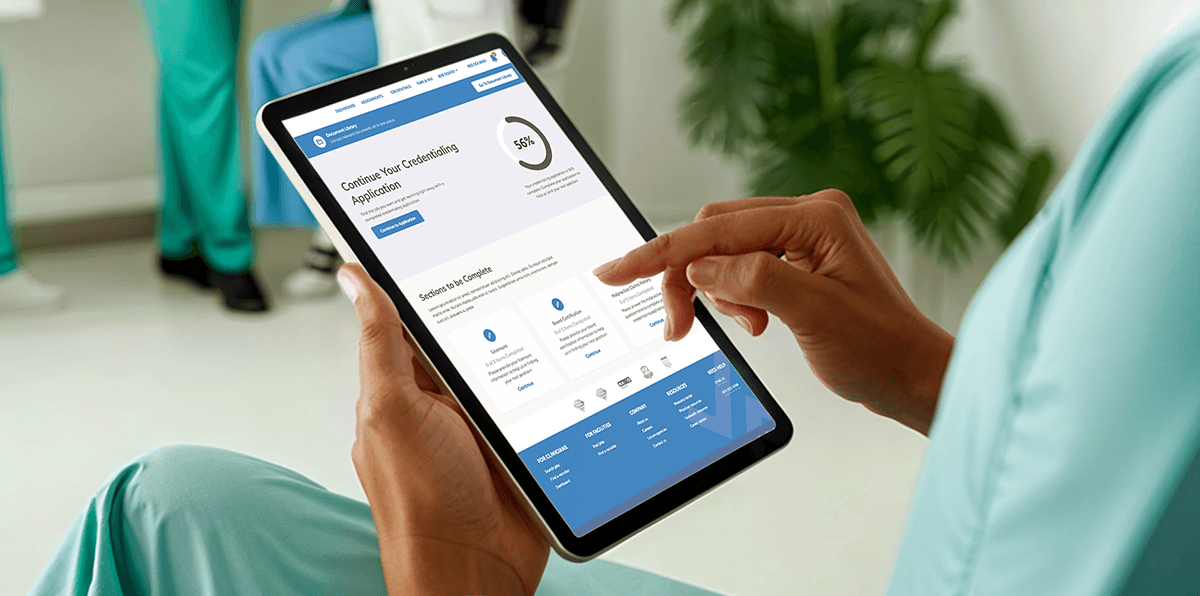
OneSpring led a rapid UX/UI redesign focused on automating data entry and optimizing the user profile and application flows for clinicians
The project utilized expert reviews and iterative prototyping to align stakeholders and balance technical feasibility with strict brand standards
Result: A streamlined, responsive platform that reduced manual errors, improved completion rates, and laid the foundation for broader digital transformation
Modernizing Healthcare Staffing
In the fast-paced world of healthcare staffing, every day a clinician spends stuck in paperwork is a day they aren't treating patients. LocumTenens, a leader in the industry, partnered with OneSpring to overhaul its outdated, paper-based credentialing system. The goal was to enhance the user experience, making the system easier to navigate while optimizing the transition from initial profile creation to final credentialing.
The Challenge: Overcoming Manual Friction
LocumTenens faced a series of challenges stemming from its legacy workflows. The paper-based system was cumbersome for clinicians and inefficient for internal teams, often leading to incomplete applications and inconsistent data. Key obstacles included:
Manual workflows that introduced friction and delayed placement of healthcare providers.
Disorganized navigation that made it difficult for clinicians to complete applications without significant support.
Lack of automation, resulting in excessive manual data entry and a high risk of errors.
The Solution: Rapid UX/UI Redesign and Alignment
To address these challenges, OneSpring implemented an expedited plan involving expert reviews and a comprehensive UX/UI redesign. By focusing on user personas and relevant metrics, the team was able to align stakeholders around a shared vision. OneSpring transformed the high-friction process into a streamlined, intuitive application journey that met modern web standards and aligned with LocumTenens' brand integrity.
Higher completion rate
62%
Faster completion time
47%
More Accurate Data
33%
Conclusion
OneSpring helped LocumTenens transform a complex, manual credentialing process into a streamlined and delightful user journey by focusing on automation, clarity, and guided interactions. The rapid redesign successfully balanced brand integrity and technical feasibility, accelerating the company's move toward a fully digital clinician experience.
Frequently Asked Questions
What is LocumTenens and what was their primary digital challenge?
LocumTenens is a prominent healthcare staffing organization. Their primary challenge was a legacy, paper-based clinician credentialing process that was slow, prone to data entry errors, and created a poor experience for the medical professionals they were trying to place.
How did OneSpring improve the clinician credentialing process?
OneSpring redesigned the user profile and application workflows to be digital-first. This included streamlining navigation, optimizing data entry fields to reduce cognitive load, and introducing automation to ensure data accuracy as clinicians transitioned through the credentialing phases.
What role does "stakeholder alignment" play in healthcare IT projects?
In large healthcare organizations, different departments often have conflicting priorities. OneSpring used expert reviews and iterative prototyping to bring product, technical, and brand teams together, ensuring the final design met business goals while providing an optimal user experience.
Why is automation important in healthcare staffing platforms?
Automation reduces the "time-to-fill" for critical healthcare positions. By automating data entry and validation, the platform reduces the need for manual follow-ups by support teams and ensures that clinicians can complete their requirements faster and more accurately.
How did OneSpring ensure the new design was adopted by clinicians?
The design was built on deep user persona research. By understanding the specific needs and pain points of clinicians—who are often working under high pressure—OneSpring created a non-intuitive, responsive flow that allowed them to complete tasks quickly on any device.
What are the benefits of a "rapid redesign" for enterprise healthcare companies?
A rapid redesign allows companies to address critical usability blockers within a compressed timeline. This approach minimizes the risk of project "scope creep" and delivers immediate value to users while the broader digital transformation strategy continues to evolve.