

Key Takeaways
AI enablement is the strategy and infrastructure that makes AI actually work inside your organization.
It covers three pillars: data preparation, system connectivity, and secure access controls.
AI enablement applies to both enterprise teams and individual workers.
Done right, it turns AI from a tool into a core part of how your business operates.
What Is AI Enablement?
AI enablement is the process of making AI work inside your organization. It means building the right environment for AI to succeed. That includes your data, your systems, and your people.
Most companies struggle to get AI off the ground. They buy tools but see little return. The missing piece is almost always enablement — the strategy that connects AI to real workflows.
AI enablement is not just a tech project. It is a business strategy. It ensures AI integrates with what you already use and delivers measurable results.
What Are the Three Steps of AI Enablement?
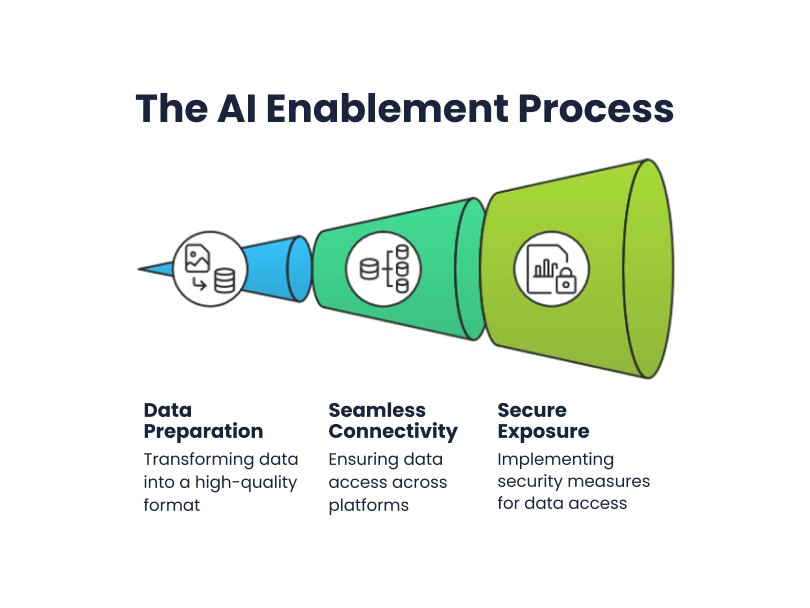
An effective AI enablement strategy has three core steps.
1. Data Preparation
AI runs on data. Bad data means bad results. The first step is making sure your data is clean, labeled, and ready.
This includes data classification, semantic analysis, and metadata tagging. These techniques help AI understand your information. They reduce errors like hallucinations and wrong answers.
2. Seamless Connectivity
AI needs access to your full data ecosystem. That means connecting CRMs, databases, cloud storage, and project tools.
Without this, AI only sees part of the picture. Siloed data limits what AI can do. Good connectivity gives AI a complete view of your organization.
3. Secure and Appropriate Exposure
Security is not optional. You must control who sees what — and how AI uses it.
AI enablement platforms use role-based access, encryption, and secure APIs. These protect sensitive data and keep you compliant with regulations.
These same principles apply to individual AI use. When using tools like ChatGPT or Claude, think about your prompt clarity, the data you share, and how tools connect. Try different models to find what works best for your needs.
Why Does AI Enablement Matter?
Many AI investments stall before they reach full deployment.
Why? Companies underestimate what it takes to integrate AI. They focus on the tool, not the foundation. AI enablement fixes that.
With the right enablement in place, AI projects move from pilot to production. ROI improves. Teams actually use the tools they are given.
How Does AI Enablement Improve Operational Efficiency?
AI Enablement Services connect deeply with your existing workflows. They make data-driven insights available at the right moment.
Employees spend less time on repetitive work. They focus on higher-value tasks. The result is better productivity, fewer errors, and improved service quality.
How Does AI Enablement Drive Innovation?
AI enablement gives organizations a flexible, scalable AI infrastructure. Teams can test new ideas quickly. They can deploy solutions and scale them fast.
Generative AI is opening new business models. Companies with strong enablement can act on these opportunities. Those without it fall behind.
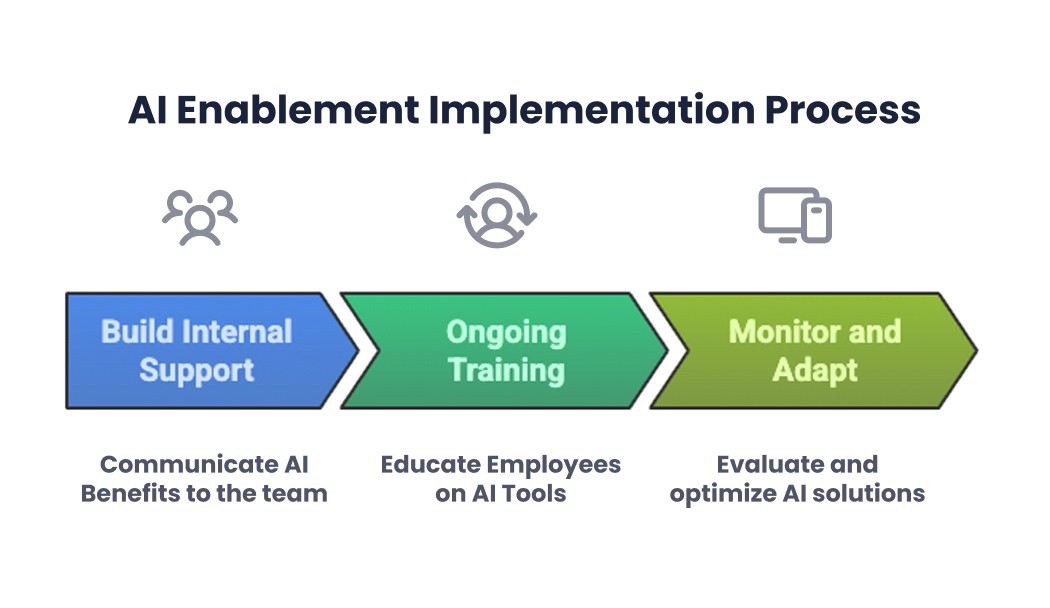
How Do You Successfully Implement AI Enablement?
Success requires more than technology. It requires people and process changes too.
Build Internal Support: Show your team how AI helps them. Use specific examples from their daily work. Early wins create momentum and buy-in.
Ongoing Training: Equip employees to use AI tools with confidence. Reduce resistance through education. Make training a continuous investment, not a one-time event.
Monitor and Adapt: Set performance metrics. Review them regularly. Adjust AI tools as your business needs evolve.
Where Is AI Enablement Being Used Today?
AI enablement is transforming industries across the board. Here are some real-world examples.
Healthcare: Providers use AI to analyze patient data. This leads to faster diagnoses and personalized treatment plans. AI handles routine tasks so clinicians can focus on complex cases.
Finance: Banks use AI to detect fraud in real time. AI predicts market trends and powers personalized investment advice. Customer service platforms reduce costs while improving the client experience.
Education: AI adapts learning content to each student. It automates grading and administrative tasks. Educators spend more time on teaching and student support.
Retail: Retailers analyze customer behavior at scale. AI personalizes product recommendations and optimizes inventory. Chatbots handle customer service and drive conversions.
In every case, AI enablement is the reason these applications work. It connects AI to real data. It keeps it secure. And it helps teams use it effectively.
What Are the Best Practices for AI Enablement?
1. Align AI with Business Goals. Know which processes AI should improve. Build a roadmap before you deploy. Strategy first, tools second.
2. Invest in Training. Skills gaps slow AI adoption. Give employees the tools and time to learn. Make AI education part of your culture.
3. Prioritize Data Quality. Garbage in, garbage out. Clean your data. Set governance policies. Protect sensitive information from the start.
4. Build Ethical Guidelines. AI must be used responsibly. Create an AI ethics committee. Audit your systems regularly. Transparency builds trust.
5. Measure and Improve. Set KPIs for your AI initiatives. Review them often. Use the data to improve what is not working.
6. Foster a Culture of Innovation. Encourage experimentation. Share what works. Recognize teams that find new AI applications. Stay curious.
The Bottom Line
AI enablement is not optional anymore. It is what separates AI success from AI failure.
Prepare your data. Connect your systems. Secure your access. Train your people. Then measure what you build.
This is how AI becomes a core part of your operations — not just a pilot that never scales.
Frequently Asked Questions
What is AI enablement?
AI enablement is the strategy, infrastructure, and process that allows organizations to successfully adopt and scale AI. It involves three pillars: preparing high-quality data, connecting AI to existing systems, and securing access to that data. Without enablement, AI tools often fail to deliver real business value. AI enablement ensures your AI investments are grounded in solid foundations — not just exciting demos.
How is AI enablement different from AI implementation?
AI implementation is the act of deploying a specific AI tool or model. AI enablement is broader. It covers the entire foundation that makes implementation successful — data quality, system connectivity, security, training, and governance. You can implement AI without enablement. But without enablement, most implementations fail. Enablement is what makes implementation stick and scale.
What types of organizations benefit most from AI enablement?
Any organization that handles significant data or complex workflows can benefit. This includes healthcare providers, financial institutions, retailers, manufacturers, and legal firms. But AI enablement also applies to individual contributors. A single employee who learns to use AI tools effectively — with good prompts, clean data, and secure practices — is practicing AI enablement at a personal scale.
How long does AI enablement take?
It depends on your starting point. For organizations with fragmented data and legacy systems, enablement may take several months. For companies with cleaner infrastructure, meaningful progress can happen in weeks. For individuals, the learning curve can be days or hours. The key is to start with a specific use case rather than trying to enable everything at once.
Does AI enablement require replacing existing technology?
Usually not. AI enablement is designed to work with what you already have. Specialized connectors allow AI to integrate with your CRM, databases, cloud storage, and other tools without tearing out your current stack. For personal use, platforms like Make.com and Zapier make it easy to connect apps and embed AI into existing workflows without writing code.
How does AI enablement affect employees?
Done well, AI enablement reduces repetitive work and frees employees to focus on higher-value tasks. It does not replace people — it extends what they can do. Employees who are trained and supported through enablement report higher job satisfaction and confidence. Resistance to AI usually drops when workers see it solving real problems in their day-to-day work.
What does it mean to be AI-enabled?
An AI-enabled organization has successfully integrated AI into how it operates. AI is embedded in daily workflows. Data infrastructure supports AI systems. Teams are trained to work alongside AI tools. Results are measured and improved over time. Being AI-enabled does not mean removing human judgment. It means using AI to amplify human capabilities — handling repetitive tasks, surfacing insights, and enabling faster decisions.
Ready to become AI-enabled? Explore our AI Enablement services to start your transformation.