The Rise of Fractional Work How Senior Professionals Are Reshaping the Modern Workforce


Key Takeaways
Companies struggle to afford full-time senior executives — fractional work solves this by giving organizations C-suite expertise at a fraction of the cost.
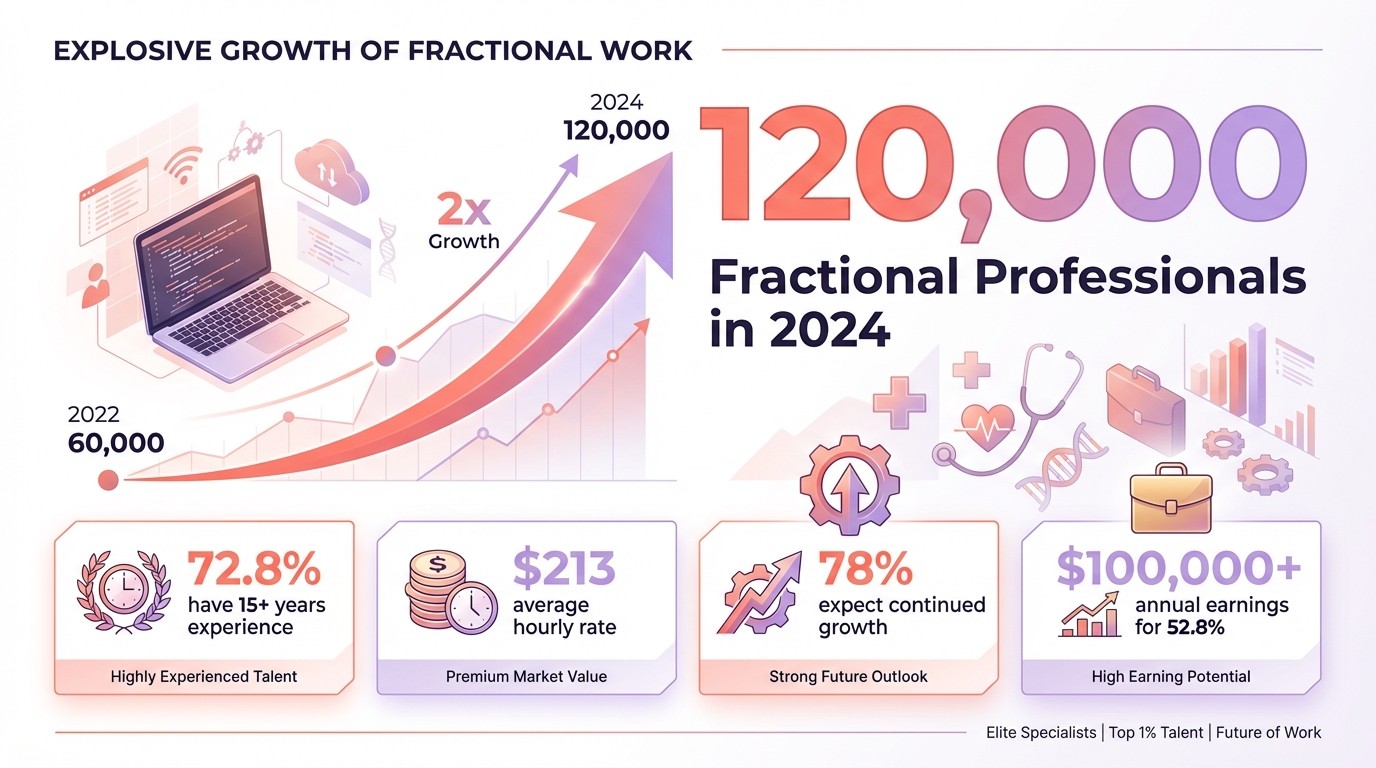
Fractional professionals have doubled from 60,000 to 120,000 between 2022 and 2024, making this the fastest-growing segment of the flexible workforce.
Over 70% of fractional executives bring 15+ years of experience, commanding average rates of $213/hour and earning $100,000+ annually.
Technology, healthcare, and professional services lead fractional adoption — with companies preferring experienced part-time leaders over costly full-time hires.
78% of fractional leaders expect continued growth, driven by AI integration, remote work, and changing business needs.
Hiring a full-time executive costs $200,000–$400,000 per year — a price many growing companies simply cannot justify. Fractional work offers a better path: senior-level professionals who embed inside your organization part-time, delivering the same strategic impact at a fraction of the cost. In just two years, the number of fractional professionals doubled from 60,000 to 120,000, signaling a permanent shift in how businesses build leadership teams. Whether you are a startup that needs a seasoned CMO or a mid-market company navigating a growth phase, fractional work gives you access to top talent on your terms.
Unlike traditional gig workers who complete short-term tasks, fractional professionals integrate into company operations with real decision-making authority. They attend leadership meetings, manage teams, and own strategic outcomes — just on a part-time schedule. This model creates new opportunities on both sides: businesses get cost-effective access to executive talent, and experienced professionals gain the flexibility to work across multiple companies without giving up income or impact.
What Is Fractional Work — And How Is It Different from Consulting?
Fractional work is not consulting. Consultants are hired to solve a specific problem and deliver a report. Fractional professionals are hired to lead — they join your team, take ownership of a function, and execute week over week. The engagement is ongoing, typically structured as a monthly retainer rather than a project fee.
A fractional CMO, for example, might work 15 hours per week for a SaaS company — setting marketing strategy, managing the team, and reporting to the CEO. They carry the same responsibilities as a full-time CMO, just on a compressed schedule. This is what separates fractional leadership from traditional part-time or contract work.
The shift from project-based to retainer-based fractional engagements has been crucial for creating sustainable business models. Fractional professionals can focus on delivering value to existing clients rather than constantly chasing new projects. Companies benefit too — they get consistent access to expertise without the uncertainty of a project deadline.
How Fast Is Fractional Work Growing?
The numbers tell a clear story. The fractional workforce doubled from 60,000 to 120,000 professionals between 2022 and 2024 — a 100% increase that outpaces traditional consulting, freelance work, and standard employment growth by a wide margin. This is not a niche trend. It is becoming a mainstream workforce strategy.
Fractional sales leadership alone expanded from 5,000 professionals in 2020 to 9,000 in 2024 across the US and Canada — an 80% increase in four years spread across 29 states. Compensation is keeping pace: average monthly pay for fractional sales leaders reached $9,651 in 2024, positioning fractional work as the premium tier of flexible employment.
While many gig platforms compete on price for commoditized tasks, the fractional market runs on expertise differentiation. Fractional professionals command hourly rates that often exceed what they earned in full-time roles — because they bring proven results, not just hours.

The geographic concentration in tech hubs like Silicon Valley, Seattle, and Austin reflects early adoption by technology companies. But the expansion across 29 states shows that remote work and rising demand are democratizing fractional talent well beyond coastal markets.
Who Becomes a Fractional Professional?
The Experienced Executive
The core of the fractional workforce is made up of seasoned professionals with deep domain expertise. Statistics show that 72.8% of fractional executives have 15 or more years of experience — a concentration of seniority rarely seen in any other employment category. These are former C-suite leaders, senior directors, and department heads who now apply their expertise across multiple companies at once.
They bring more than knowledge — they bring proven track records, established networks, and the ability to make confident strategic decisions without a lengthy ramp-up. Their career history allows them to add expert value quickly, delivering senior-level output in compressed timeframes. Many are former executives who have reached career peaks and now prioritize selective engagements over traditional retirement.
The Lifestyle Optimizer
A growing segment of fractional professionals choose this path to reclaim control over their schedule without sacrificing meaningful work or income. Parents, caregivers, and professionals who value geographic freedom find that fractional arrangements offer executive-level flexibility that traditional part-time roles simply do not provide.
Portfolio career builders use fractional work to diversify income and experience across multiple industries. Rather than depending on a single employer, they spread their expertise across clients — reducing financial risk and gaining exposure to different business models, cultures, and challenges. This diversification builds long-term value and resilience.
The Strategic Specialist
Some fractional professionals succeed because of highly specific expertise in areas experiencing outsized demand. AI implementation, cybersecurity, digital transformation, and emerging technologies are all fields where qualified talent is scarce. Companies need this expertise, but rarely need it full-time — making fractional arrangements a natural fit.
Fractional CMOs, CFOs, and CTOs have become increasingly common as companies recognize that strategic leadership in these functions does not require 40 hours per week — especially in smaller organizations or during specific growth stages. Thought leaders in emerging fields also gravitate toward fractional models as a way to stay current across multiple industry applications while monetizing their expertise.
Which Industries Are Adopting Fractional Leadership Fastest?
Technology and SaaS
Technology leads all industries in fractional adoption, with 75% of tech companies planning to hire fractional workers by 2024. SaaS companies in particular benefit from fractional arrangements because their growth stages often require specialized expertise for short windows — a fractional CTO guiding architectural decisions during a product scaling phase, for example, or a fractional VP of Sales building out a new territory.
AI is accelerating demand. As companies navigate rapidly evolving capabilities and risks, they need experienced guidance that many cannot afford full-time. Fractional arrangements let organizations access cutting-edge expertise while staying flexible as the technology landscape shifts. Early-stage startups use fractional leaders to access senior-level guidance they could not otherwise afford; scaling companies use them to solve specific challenges during high-growth phases.
Healthcare
Healthcare has embraced fractional arrangements to fill leadership gaps across diverse settings. Rural hospitals, specialty clinics, and healthcare startups all benefit from fractional medical directors and administrators who bring deep expertise without requiring a full-time hire. Geographic constraints that once limited access to experienced healthcare leadership are now overcome through remote work and fractional models.
Healthcare startups face especially complex regulatory environments that demand experienced guidance during critical development phases. Fractional professionals with backgrounds in compliance, EHR implementation, or healthcare data analytics provide exactly the right expertise at exactly the right time — without the overhead of a full-time team member.

Professional Services
Marketing agencies, consulting firms, and professional services organizations have become leaders in fractional engagement — both as adopters of fractional talent and as providers of fractional services to their clients. Companies like OneSpring and TalentLoft have grown as the fractional market has taken off. The project-based nature of professional services work aligns naturally with fractional models.
Fractional business development and sales leadership dominate professional services engagements. Legal and financial services firms access specialized expertise on-demand for matters that don’t justify full-time staff — M&A advisory, regulatory compliance, or specialized financial analysis. Creative agencies use fractional creative directors and strategy leads to deliver premium work while managing costs effectively.
What Are the Real Benefits of Fractional Work for Companies and Professionals?
For companies, the most immediate benefit is cost. A fractional CMO might cost $8,000–$12,000 per month — compared to $300,000+ annually for a full-time executive when salary, benefits, and equity are factored in. That gap in cost allows smaller organizations to access senior-level leadership that was previously out of reach.
Beyond cost, fractional work gives companies three things that are hard to find elsewhere:
Flexibility — Scale leadership up or down based on actual business needs, not fixed org structures.
Reduced hiring risk — A 12–24 month fractional engagement gives you time to evaluate fit before making a full-time offer.
Cross-industry insight — Fractional leaders working across sectors bring fresh perspectives and best practices from adjacent industries.
For professionals, the appeal is equally strong. More than half (52.8%) of fractional professionals earn $100,000+ annually — many earning more than they did in full-time roles while working fewer total hours. Work-life balance, autonomy, and intellectual variety all rank as top reasons experienced professionals choose fractional careers over returning to traditional employment.
What Are the Challenges of Fractional Work?
Fractional work is not without real trade-offs. Client acquisition remains the biggest hurdle — 74% of fractional professionals rely on networking and referrals to find new business. This dependence on personal networks can limit growth and create income volatility for professionals who have not built strong relationship-based pipelines.
Standing out in a growing field is increasingly difficult. As more experienced executives enter the fractional space, differentiation becomes critical. Professionals must clearly articulate what makes their expertise unique — and invest in personal branding in ways that traditional employment never required.
Other common challenges include:
Time management complexity — Juggling 4–5 clients requires sophisticated systems for managing priorities, deliverables, and context-switching.
Income unpredictability — Despite high average earnings, irregular payments and client turnover demand stronger financial discipline than traditional employment.
Scope creep — Part-time arrangements create pressure to expand work beyond agreed hours without corresponding compensation increases.
Scaling limits — Individual fractional professionals face natural capacity ceilings that require strategic planning — or partnerships — to overcome.

The limited diversity in the fractional workforce is also a systemic challenge. Current fractional professionals are predominantly white and male, reflecting historical patterns in senior executive roles. Expanding fractional opportunities to underrepresented groups requires intentional effort and structural change in how fractional professionals are identified and sourced.
What Does the Future of Fractional Work Look Like?
The trajectory of fractional work points toward continued expansion. AI integration is a major catalyst — 68% of fractional professionals already use AI tools to deliver higher value in shorter timeframes, making their services even more cost-effective for clients while enabling them to serve more organizations simultaneously.
Purpose-built fractional platforms are emerging to replace general gig marketplaces. These platforms understand the unique dynamics of fractional arrangements — ongoing relationships, retainer pricing, strategic roles — and are developing specialized matching capabilities that general freelance sites cannot replicate.
Looking further out, several trends are shaping the future of fractional work:
Professional certifications and standards specific to fractional work are likely to emerge, helping clients evaluate quality and helping professionals signal credibility.
Fractional roles are moving from tactical stop-gaps to permanent organizational design choices — incorporated into workforce plans from the start.
Collaborative fractional teams with complementary skills may unlock larger engagements and address the scaling limits individual professionals face today.
Government policy may eventually recognize fractional work as a distinct employment category, providing greater clarity on classification, benefits, and compliance.
With 78.4% of fractional professionals optimistic about future opportunities, the evidence points to fractional work becoming a permanent, mainstream component of how organizations build and scale their leadership — not a temporary workaround, but the new normal.
Frequently Asked Questions
What is fractional work and how does it work?
Fractional work is an arrangement where experienced professionals provide part-time leadership to multiple companies simultaneously, typically on a monthly retainer. A fractional executive — such as a CMO, CFO, or CTO — works 10–20 hours per week for each client, attending meetings, setting strategy, and managing teams just as a full-time leader would. The key difference is that the professional splits their time across 3–5 clients rather than committing exclusively to one organization.
How does fractional work differ from traditional consulting?
Fractional professionals are embedded team members with ongoing operational responsibility; consultants are project-based advisors who deliver a specific output and leave. A fractional CMO manages your marketing team, owns the strategy, and reports to your CEO every week. A consultant produces a marketing strategy document. Fractional engagements typically run 12–24 months with consistent monthly hours, while consulting projects have defined start and end dates with specific deliverables.
How much do fractional executives earn?
Average hourly rates across the fractional market are approximately $213, with many professionals earning $100,000 or more annually. Fractional sales leaders averaged $9,651 per month in 2024. Total earnings depend on the number of concurrent clients (most fractional professionals manage 4–5), the seniority and specialization of the role, and the industry. Many fractional professionals report earning as much or more than they did in full-time executive positions, while working significantly fewer total hours.
What experience do you need to become a fractional executive?
Most successful fractional executives have 15 or more years of industry experience, and 72.8% of current fractional professionals meet that threshold. Prior C-suite or senior leadership experience is important because clients expect fractional hires to operate independently and make high-stakes decisions without lengthy onboarding. Deep expertise in a specific function — marketing, finance, technology, operations — is more important than broad generalist experience, since clients hire fractional leaders specifically for their domain knowledge.
Which industries use fractional executives the most?
Technology and SaaS companies lead fractional adoption, with 75% of tech companies planning to hire fractional workers. Healthcare organizations use fractional leaders to fill specialized roles in rural, startup, and compliance-heavy settings. Professional services firms — marketing agencies, consulting firms, legal and financial services — also rely heavily on fractional talent. The model has expanded well beyond coastal tech hubs, with adoption now spread across 29 US states and growing internationally.
Is fractional work a sustainable long-term career?
Current data suggests it is. More than 62% of fractional professionals report satisfaction with their business model, and 78.4% expect continued growth in opportunities. Income diversification across 4–5 clients provides more stability than dependence on a single employer, and the ability to adjust engagements based on demand creates flexibility during market shifts. Many fractional professionals supplement client work with speaking, writing, and digital products — creating multiple revenue streams that enhance long-term financial sustainability.
How do companies find and hire fractional professionals?
Referrals and professional networks account for 74% of fractional hiring decisions, making relationship-building the most important sourcing channel. Industry associations, mastermind groups, and LinkedIn are common entry points. Purpose-built fractional marketplaces are emerging as an alternative to general freelance platforms, offering better matching for strategic roles. If you are looking for a fractional executive, starting with a warm introduction through your existing professional network will typically produce the best results fastest.