
You control AI agents by treating them as managed assets: know where you sit on the exploration–coordination–optimization path, risk-tier each agent by blast radius, and keep a living registry of ownership, access, and dependencies. Without that coordination layer, overlapping agents, silent breakages, and unanswerable board questions become the default.
What you'll learn from this article: This article is about gaining some level of control over the number of AI agents that may exist within your team and company. It is not uncommon for companies to have hundreds, if not thousands, of agents running at any given time, with only a fraction of them potentially delivering any kind of value to the organization.
In this article, I'll go over the three-stage maturity model for understanding where your AI agent initiative stands, five questions to get an honest read on your coordination gaps, a simple risk-tiering framework, and one concrete first step you can take this week.
A few months ago, I was working with a team that had done everything right. They had a clear AI strategy, executive buy-in, and a handful of well-scoped agents already in production. One agent handled internal knowledge retrieval, another summarized customer feedback, and a third drafted first-pass responses for the support queue.
On paper, it looked like progress. In practice, it felt like chaos.
Nobody knew which agent owned which task when they overlapped. Two teams had independently built agents that did nearly the same thing. The knowledge retrieval agent was being called by three different workflows, but nobody had documented that dependency, so when the team updated its underlying data source, two processes broke silently. And when leadership asked a simple question, "What are our agents actually doing?" nobody could answer it confidently.
This is not a story about a team that moved too fast. It is a story about a team that hit a completely predictable inflection point and didn't have the right frame to recognize it.
If you have AI agents running in your organization, you will hit this moment. The question is whether you see it coming.
How to Know Where You Stand
Before you can move forward, you have to understand your current state. One side effect of Stage 1 (Exploration) is the sheer amount of output most organizations have likely created. When I talk about output, I mean the number of agents and materials created that provide some value or minimal value. A fast and simple way to get to the core of what exists can be achieved by asking yourself these five questions:
Can you name every agent running in your organization right now? Not the ones your team built. All of them, across every department and vendor relationship.
Do you know what data each agent can access, and what it is authorized to do with that data? Access and authorization are not the same thing. Many teams have answered the first question but not the second.
If an agent produced a wrong or harmful output today, who would own that? If the answer is "it depends" or "we'd figure it out," you do not have accountability structures in place.
Do any of your agents share dependencies, like data sources, APIs, or downstream processes, that have not been formally documented? Silent dependencies are where this problem lives.
When a new team wants to build an agent, is there a defined process for how that happens? Or does each team make its own decisions in isolation?
If you answered "no" or "I'm not sure" to two or more of these, you are in stage two. That is not a failure. It is a signal that the coordination layer needs to be built. Keep in mind that the coordination layer is complex, especially for a large organization with many moving pieces. It's one thing to focus at the individual level, where somebody can control their universe more clearly. It's a totally different thing to have a team of individuals all working towards a common goal using technology and skills to achieve some output.
Oftentimes, the output is vast and includes material that makes it difficult for any one individual to comprehend, let alone understand. The first step is to understand what you have in place and gain some control over how you manage these assets.
Three Stages Every Agent Initiative Goes Through
In my experience working with companies across industries, AI agent initiatives tend to move through three recognizable stages. Most teams are somewhere in the middle of stage two without realizing it. Most of you reading this article are familiar with the exploration stage. In many cases, this is called the experimentation stage. Either way, it's where people explore the available technology and how they can achieve value from it.
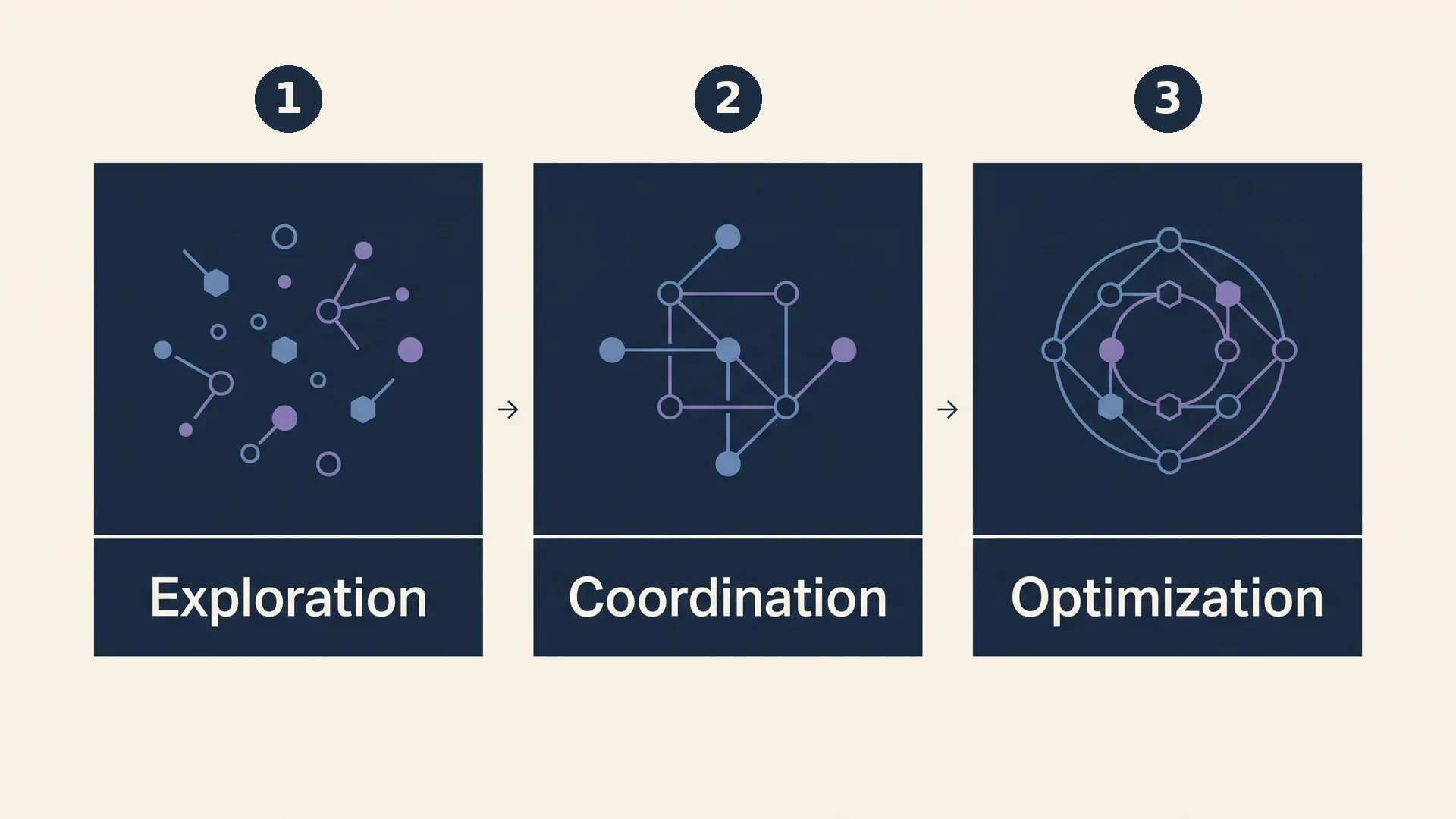
Three stages of AI agent maturity: exploration, coordination, and optimization.
Stage 1: Exploration
This is the exciting part. A team identifies a high-value use case, builds an agent, and it works. Maybe it saves hours of manual work. Maybe it surfaces insights that would have taken days to compile. The proof of value is real, and momentum builds quickly.
The defining characteristic of this stage is autonomy. Individual teams or practitioners are moving fast, experimenting, and learning. That is exactly what should happen. The risk is treating this stage as the destination rather than the starting line.
Stage 2: Coordination
This is where most organizations are right now. Multiple agents exist across the business. Some were built by the same team; many were not. They may share data sources, overlap in scope, or depend on each other in ways that were never formally mapped.
The defining characteristic of this stage is ambiguity. Who owns what? What is each agent actually authorized to do? What happens when two agents produce conflicting outputs? These questions do not have obvious answers yet, and that gap is where risk accumulates quietly.
Stage 3: Optimization
Organizations that navigate stage two successfully arrive here. Agents are treated as managed assets, not experiments. There is a clear picture of what exists, what each agent is responsible for, and how they interact. New agents are introduced through a defined process rather than ad hoc.
The defining characteristic of this stage is intentionality. The organization is not just running agents; it is governing them.
The goal is not to slow down. It is to build the coordination layer that lets you move faster, with fewer surprises, at greater scale.
Not All Agents Carry the Same Risk
One of the most useful reframes I offer clients is this: governance does not mean treating every agent the same. It means treating each agent according to its actual level of risk and impact. One key criterion is understanding how much flexibility you want to give an agent. Some of them are assistive agents that help us complete various tasks, while others may be fully autonomous. While most organizations don't operate many fully autonomous agents, the trend is moving in that direction. The key question here is who owns the agent. In other words, if you have ownership, you have the power to cut the cord if you need to, or to make corrections.
The ownership question is one of the main questions I hear regularly from people. They create agents and workflows and automate tasks, but they're not clear on who has official ownership over such things.
A simple tier model helps make this practical. As agents get labeled, it's important to understand their tier level. This allows us to assign associated risks to agents and treat them accordingly.
On smaller screens, swipe across the table to compare all four columns.
Tier | Scope | Examples | Governance Need |
|---|---|---|---|
1 - Assistive | Supports a single user, no external actions | Writing assistant, meeting summarizer | Low. Document it, assign an owner. |
2 - Workflow | Operates within a defined process, limited scope | Support queue triage, data enrichment | Medium. Define inputs, outputs, escalation paths. |
3 - Autonomous | Takes actions, accesses sensitive data, or touches multiple systems | Customer-facing agents, agents with write access | High. Full accountability chain, audit trail, human review gates. |
The mistake most organizations make is applying tier-three scrutiny to everything, which creates so much friction that teams stop asking for permission and start building in the shadows. The goal is proportional governance: light-touch for low-risk agents, rigorous oversight for high-stakes ones.
The question to ask for any new agent: If this agent made a mistake at scale, what would the blast radius be? The answer tells you which tier it belongs in.
You Know It Is Time to Act When...
Most executives I work with already sense the inflection point before they can name it. For example, my team recently worked on a project and hit the inflection point about midway through. They were producing so much output that it became hard to control. Small changes required a lot of work because there was so much context to go through. This creates a negative context loop: as you produce more output, the output on top of that starts to grow exponentially because of the increased context. Here are the signals to watch out for.
Two teams built the same agent without knowing it. This is the clearest sign that discovery and coordination are missing.
An agent broke something, and nobody knew why. Undocumented dependencies surface as mysterious failures.
You cannot answer a board question about AI risk with confidence. If someone asked you today what your agents can access and what they are authorized to do, could you answer in under five minutes?
Teams are avoiding the governance process because it feels too slow. This means the process is miscalibrated, not that governance is the wrong idea.
A new vendor or partner wants to connect their agent to yours. Multi-agent coordination across organizational boundaries requires a much higher level of clarity than internal use alone.
Any one of these is a reasonable trigger. Two or more means the window for proactive action is closing.
The First Concrete Step: Build an Agent Registry
The single most impactful thing an organization can do at stage two is build an agent registry. Not a governance policy. Not a committee. A registry.
Think of it as a living document, a shared record of every agent operating in your environment. It does not need to be elaborate. A well-maintained spreadsheet is a better starting point than a sophisticated platform nobody uses.
This registry idea may sound complicated, but it's relatively straightforward. You can ask an AI agent to self-identify its use and organize it however you need.
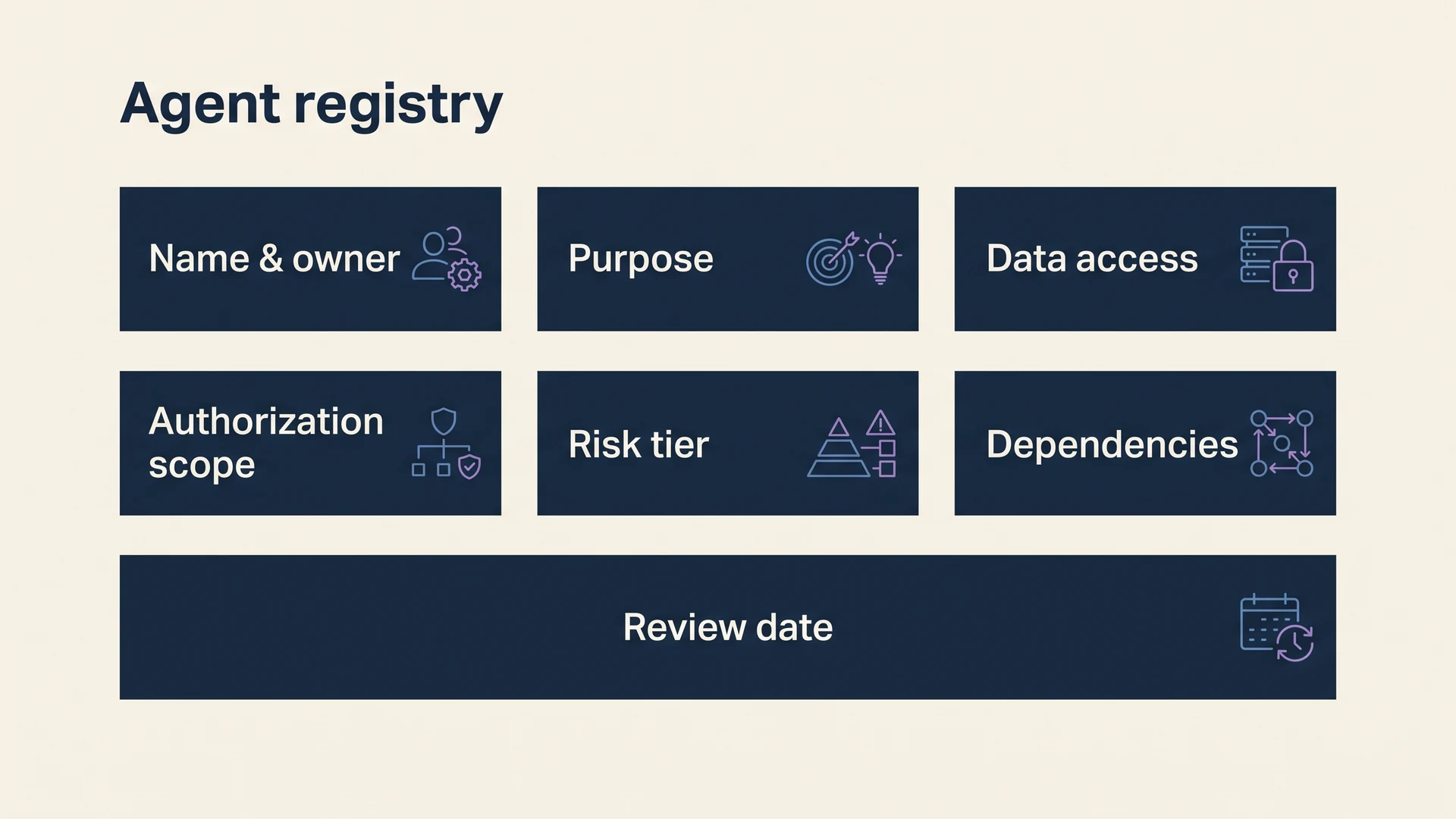
A practical agent registry captures ownership, purpose, access, permissions, risk, dependencies, and review dates.
What a basic registry captures
For each agent, you want to know:
Name and owner: Who built it, and who is accountable for it today
Purpose: What it is designed to do, in plain language
Data access: What systems, data sources, or APIs it connects to
Authorization scope: What actions it is permitted to take, and what is explicitly off-limits
Tier classification: Assistive, workflow, or autonomous
Dependencies: What other agents, processes, or systems rely on it
Review date: When it was last evaluated and when it is next due
Why this matters more than it sounds
The registry is not just a documentation exercise. It is the foundation for every governance decision that follows. When a new agent is proposed, the registry tells you whether something similar already exists. When something breaks, the registry tells you what was connected. When a board member asks about AI risk, the registry gives you a defensible answer in minutes rather than days.
That knowledge retrieval agent broke silently because nobody had mapped its dependencies. A registry would have caught that before it became a problem.
Getting started without a big project
The fastest path is a two-hour working session with the people who own your current agents. Ask each owner to fill in the registry fields for their agents. You will learn more in that session than in weeks of asynchronous documentation requests. What you discover will also tell you which agents need immediate attention and which are low-risk. The registry can be automated to a certain degree. For example, I created an instruction set that allows me to give it to an agent or an LLM and have it automatically extrapolate the registry and list out all the agents that are in the system. I did this recently for my Hermes agent, and it quickly came back with 26 agents identified, half of which were not really being used anymore. From there, I had enough information to create a dashboard that gave me a complete view into what agents I have, what they're being used for, and what categories they fall in
The registry is not the end state. It is the coordination layer that makes everything else possible.
What Comes After the Registry
Once you have visibility, the next layer is accountability. That means defining who has the authority to approve new agents, what the intake process looks like, and how agents are retired when they are no longer needed. It also means thinking about how agents interact with each other, because the future of AI in most organizations is not a collection of isolated tools. It is a network of agents that collaborate, hand off work, and share context.
That network is only as trustworthy as the governance beneath it.
The organizations I see moving fastest are not the ones with the most agents. They are the ones that built the coordination layer early enough to scale without breaking things. They treated governance not as a constraint on innovation but as the infrastructure that makes sustained innovation possible.
That team got there. It took a painful few weeks of untangling dependencies and rebuilding documentation that should have existed from the start. But once they had the registry, the tier model, and a clear accountability structure, the next phase of their agent roadmap moved significantly faster than the first.
That is the payoff. Not control for its own sake. Speed with confidence.
If your organization is in the middle of an AI agent initiative and the coordination questions are starting to pile up, we can help you get clarity. Get in touch with us here. We work with executive teams to map what exists, identify where the gaps are, and build the governance foundation that lets you move forward without the chaos.