

Key Takeaways
Maxwell Leadership's platform had navigation inconsistencies, insufficient error handling, and cognitive overload — creating a steep learning curve for users
OneSpring applied Nielsen Norman Group's 10 usability heuristics to systematically evaluate the interface and surface high-priority improvement opportunities
Navigation streamlining, real-time status indicators, and a decluttered layout significantly improved user satisfaction and task efficiency
Maxwell Leadership conducted a heuristic evaluation to assess the usability of its platform and identify areas for improvement based on established usability principles. The evaluation aimed to uncover user pain points, inefficiencies, and potential enhancements to ensure a more seamless user experience. The study leveraged Nielsen Norman Group’s ten usability heuristics as a framework to systematically evaluate the platform’s interface, interactions, and overall functionality.
Challenge
The heuristic evaluation revealed several key usability challenges that affected the platform’s efficiency and user satisfaction. Users experienced inconsistencies in navigation, making it difficult to locate essential features and complete tasks efficiently. Error handling mechanisms were insufficient, often failing to provide clear feedback or guidance when issues arose. The visibility of system status was another concern, as users struggled to understand the progress of ongoing tasks due to a lack of real-time updates. Additionally, the platform’s design presented cognitive overload, with excessive information displayed on certain screens, making it harder for users to focus on critical tasks. These usability issues led to increased frustration, inefficiencies, and a steep learning curve for new users.
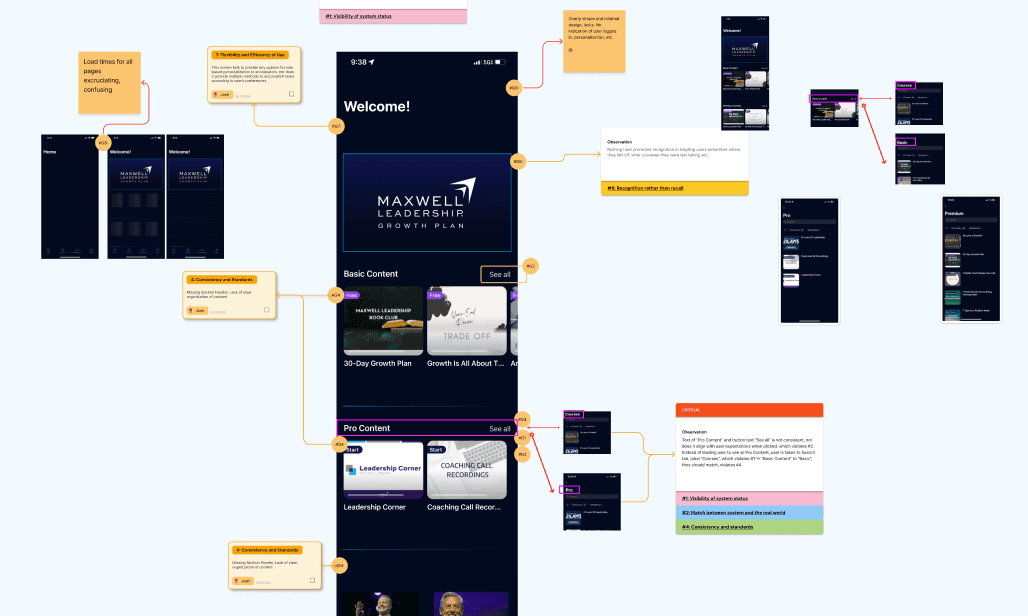
Solution
To address these challenges, Maxwell implemented a structured approach to enhance the platform’s usability. Navigation was streamlined by improving the information architecture and ensuring that frequently used features were easily accessible. Error handling was enhanced by providing clearer feedback and actionable error messages to guide users in resolving issues efficiently. System status visibility was improved by incorporating real-time progress indicators, ensuring users were informed of ongoing processes. The platform’s design was refined to reduce cognitive overload by decluttering screens, prioritizing essential information, and implementing a more intuitive layout. These solutions aimed to create a smoother and more user-friendly experience for all users.
“Maxwell Leaderships’ usability improvements have transformed the way our team interacts with the platform. The refined navigation and real-time updates make it effortless to learn lessons and complete tasks.”
— Business Operations Manager


Results
The usability enhancements led to significant improvements in user experience and efficiency. Users reported greater ease in navigating the platform, with clearer pathways to essential features. Error resolution became more intuitive, reducing frustration and enhancing overall satisfaction.
The introduction of real-time status updates allowed users to monitor tasks more effectively, increasing confidence in system operations. The streamlined interface reduced cognitive load, making it easier for users to process information and complete tasks efficiently. Overall, user feedback indicated a marked improvement in usability, reinforcing the effectiveness of the heuristic-driven design changes.
By conducting a heuristic evaluation and addressing identified usability challenges, Maxwell successfully enhanced the platform’s overall user experience. The research-driven improvements ensured a more intuitive, efficient, and user-friendly interface, reducing friction and increasing user satisfaction.
Error Reduction
40%
Increased Completion
30%
Frequently Asked Questions
What is a heuristic evaluation in UX design?
A heuristic evaluation is a usability review in which UX experts assess a product against a set of established principles — most commonly Nielsen Norman Group's 10 usability heuristics. Unlike user testing, it doesn't require recruiting participants; instead, trained evaluators identify interface problems based on their expertise.
What are Nielsen's 10 usability heuristics?
Nielsen's 10 heuristics include: visibility of system status, match between system and real world, user control and freedom, consistency and standards, error prevention, recognition over recall, flexibility and efficiency of use, aesthetic and minimalist design, help users recognize and recover from errors, and help and documentation. These principles guide expert reviews of any digital interface.
What usability problems did Maxwell Leadership's platform have?
The evaluation found inconsistent navigation that made it hard to locate features, insufficient error handling that left users without actionable guidance when problems occurred, poor visibility of system status during ongoing tasks, and screens with too much information — creating cognitive overload and a steep learning curve for new users.
How did the heuristic evaluation improve Maxwell's user experience?
Based on evaluation findings, Maxwell streamlined navigation by improving information architecture, enhanced error messages to provide clear recovery guidance, added real-time progress indicators for ongoing tasks, and decluttered screens to reduce cognitive load and surface the most important information first.
How does cognitive load affect user experience in digital platforms?
Cognitive load refers to the mental effort required to process information and complete tasks. When a screen presents too much information simultaneously, users struggle to prioritize and often make errors or abandon tasks. Reducing cognitive load — through clearer layouts and progressive disclosure — directly improves task success rates.
When should a company conduct a heuristic evaluation vs. usability testing?
Heuristic evaluations are faster and less expensive — ideal for identifying obvious usability problems early in a project or when user recruitment isn't feasible. Usability testing with real participants provides deeper insight into actual user behavior and is better for validating design solutions. Both methods are most powerful when used together.
What results did Maxwell see after implementing heuristic-driven design changes?
Users reported easier navigation, more intuitive access to key platform features, reduced frustration when errors occurred, and greater confidence in monitoring ongoing tasks. The streamlined interface lowered cognitive demands, and overall user feedback indicated a marked improvement in satisfaction and platform usability.