
Key Takeaways
Equifax's proprietary consumer report platform required too many clicks, buried customization options, and left users relying on workarounds to complete routine tasks
A mixed-method research study (surveys + in-depth interviews with existing users) surfaced a "get in, get out" mentality and informed a redesign focused on efficiency and discoverability
Post-launch: 40% improvement in satisfaction, 30% faster report retrieval, 50% increase in advanced feature adoption, 25% drop in navigation-related help desk tickets
Equifax sought to redesign a proprietary tool widely used by businesses for accessing consumer reports. Previous research, conducted four years prior, had led to feature enhancements. However, a complete redesign was needed to better align with user needs and modern usability standards. To inform this process, Equifax partnered with OneSpring to conduct a new round of user research, focusing on understanding customer workflows and pain points.
Challenge
The existing application had several usability issues that hindered efficiency and user satisfaction. Users struggled with a complex interface requiring multiple steps to access reports, leading to frustration and wasted time. Additionally, the lack of awareness around customization options meant that many users were not leveraging the full potential of the application. Training gaps further compounded the problem, leaving users to rely on inefficient workarounds. Equifax needed to address these challenges to improve the user experience and maintain its competitive edge in the market.
The study utilized a mixed-methods approach, combining a quantitative survey with qualitative in-depth interviews. An email campaign targeted existing application users, resulting in a 0.007% survey response rate and a 0.0007% interview participation rate. The research team collected responses from 28 survey participants and conducted hourlong user interviews.
The research revealed several key insights:
A majority of respondents, 86%, identified as end-users, while 14% were administrators.
Most users logged into the application primarily for report verification rather than system administration.
Companies of all sizes queried similar numbers of reports, indicating that usage intensity was more task-dependent than company-size dependent.
Frequent logins correlated with higher report queries, emphasizing the importance of a streamlined workflow.
Users exhibited a “get in, get out” mentality, prioritizing efficiency and minimizing time spent on non-essential features.
The interface required multiple clicks to access reports, causing delays. Many users were unaware of customization features that could improve their workflow, and some crucial features were underutilized due to inadequate training and visibility.
Solution
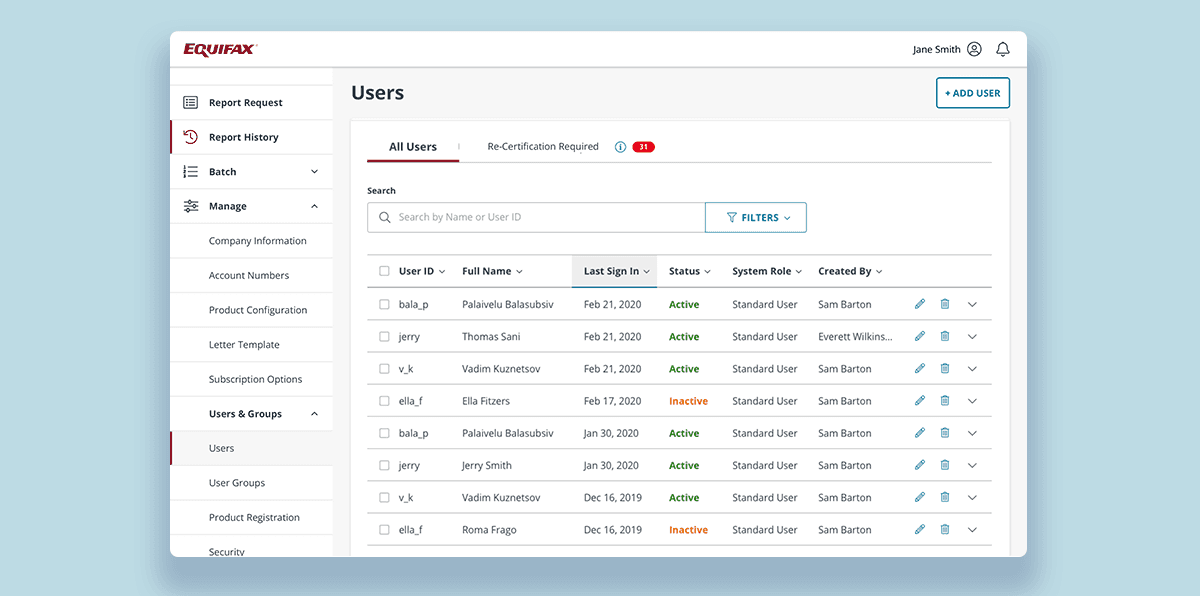
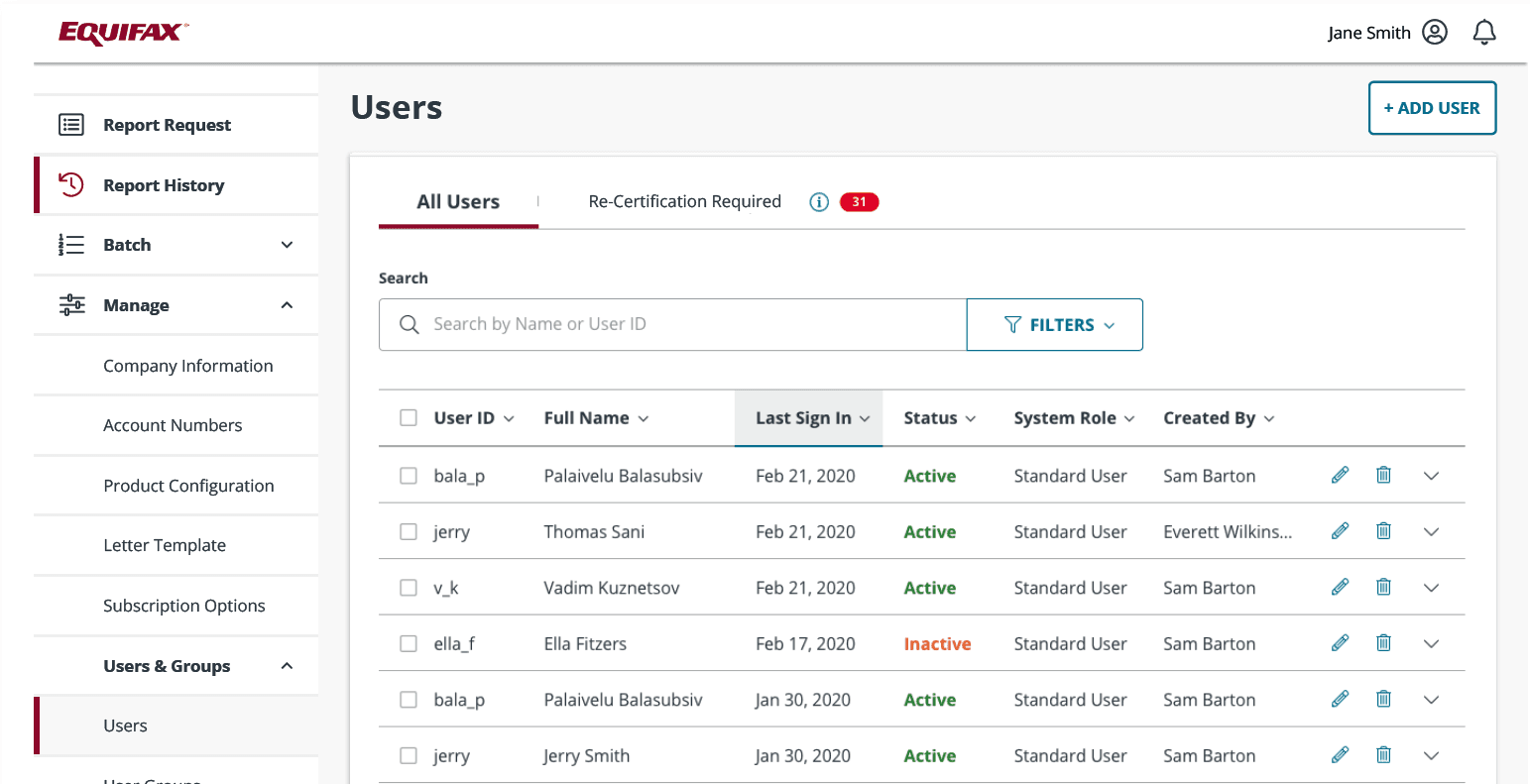
To address these challenges, Equifax implemented a user-centric redesign of the application, focusing on simplicity, efficiency, and ease of access. The redesign introduced a cleaner, more navigable interface with clearly labeled sections and streamlined workflows. Steps from login to report retrieval were reduced, enabling users to complete tasks more efficiently. Customization settings were made more visible, allowing users to tailor their experience. Comprehensive training resources, including interactive tutorials and tooltips, were introduced to increase feature adoption. Backend infrastructure enhancements improved system speed and reliability.

Results
Following the redesign, user feedback indicated significant improvements in usability and efficiency.
Post-launch surveys showed a 40% improvement in overall user satisfaction scores.
Users reported a 30% reduction in time spent retrieving reports.
Customization and advanced reporting tools saw a 50% increase in adoption rates.
Help desk inquiries related to navigation and usability dropped by 25%, indicating improved self-sufficiency among users.
Time Decreased
30%
Increased Satisfaction
25%
The redesign has transformed how we access and analyze consumer reports.
The new interface is intuitive, and the improved customization features allow us to extract insights much faster. It’s a game-changer for our team.
—Senior Financial Analyst
Frequently Asked Questions
What was the Equifax platform usability study about?
Equifax needed to redesign a proprietary application used by businesses to access consumer reports. Despite enhancements made four years prior, the platform had usability gaps that created friction for end-users. Equifax partnered with OneSpring to conduct fresh user research and inform a complete redesign aligned to modern usability standards.
What research methods were used in the Equifax usability study?
OneSpring used a mixed-methods approach combining a quantitative survey with qualitative in-depth interviews. The email campaign targeting existing users yielded 28 survey responses and a set of hour-long user interviews. This combination provided both statistical patterns and rich contextual insight into how users actually worked with the platform.
What did the research reveal about how Equifax platform users behave?
Users exhibited a "get in, get out" mentality — they logged in primarily for report verification and wanted to complete tasks as quickly as possible. Many were unaware of customization features that could improve their workflow. Frequent logins correlated with higher report query volume, underscoring the need for a streamlined, efficient experience.
What design changes did the Equifax platform redesign include?
The redesign introduced a cleaner interface with clearly labeled sections, reduced the number of clicks from login to report retrieval, made customization settings more visible, added interactive tutorials and tooltips to drive feature adoption, and improved backend speed and reliability.
What results did the Equifax platform redesign achieve?
Post-launch surveys showed a 40% improvement in overall user satisfaction. Users reported a 30% reduction in time spent retrieving reports. Customization and advanced reporting tool adoption increased 50%. Help desk inquiries related to navigation dropped 25%, indicating users could now resolve issues independently.
What does a "data-driven approach to usability" mean in practice?
It means pairing quantitative data — like survey responses, session analytics, and task timing — with qualitative insights from user interviews. This combination allows design teams to prioritize the most impactful changes rather than relying on assumptions. For Equifax, this approach surfaced the specific friction points that mattered most to high-frequency users.
Why do B2B financial platforms struggle with usability?
B2B platforms often prioritize feature completeness over ease of use, leading to complex interfaces where power users develop workarounds and infrequent users struggle to find basic functionality. Without regular research, usability debt accumulates — making even simple tasks like retrieving a report feel burdensome compared to modern consumer-grade tools.