Modernizing access to US Air Force products and services
Enabling employees and external customers to find and direct purchase supplies and services more efficiently.


Key Takeaways
The US Air Force needed an Enterprise Portal and unified UI across three Test Integration Labs — with minimal commercial precedent to reference
OneSpring partnered with SAIC to apply Lean UX methodology, running daily working sessions and building a design system using Material UI and the US Web Design System (USWDS)
Delivered the Enterprise Portal, TIL wireframes, and high-fidelity mocks on schedule; introduced UX best practices and recommended design tooling for future Air Force projects
Summary
OneSpring worked closely with SAIC, our trusted partner and project lead, to support the United States Air Force—one of the main branches of the U.S. military focused on air and space missions.
Instead of just providing a basic user experience (UX) service, we helped introduce UX best practices from the beginning. This approach gave our client the tools and knowledge to understand better and apply UX methods and best practices throughout the project.
Challenge
The U.S. Air Force needed to create an Enterprise Portal for their customers and a common user interface across 3 Test Integration Labs (TIL).
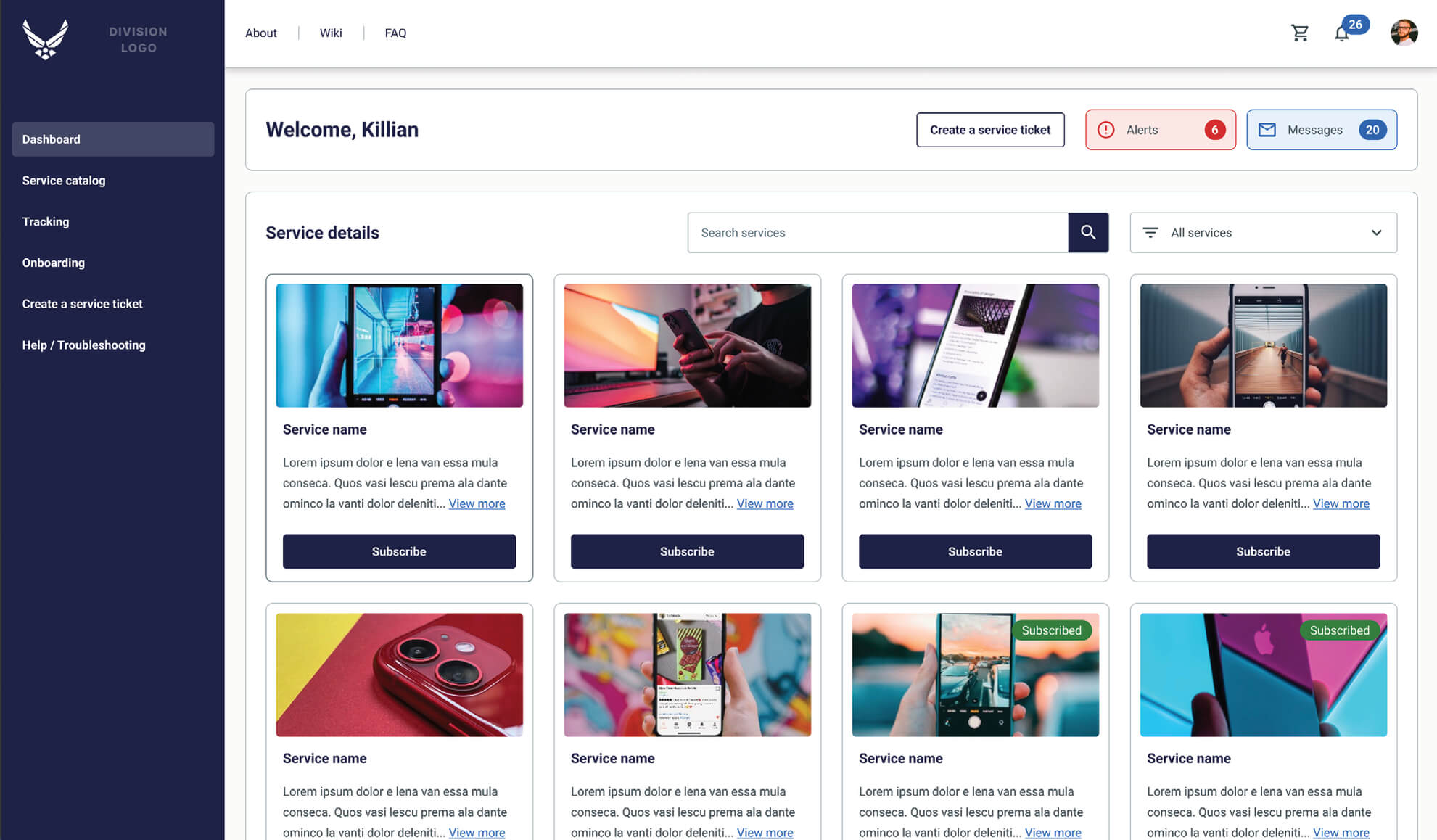
Employees and customers will also need the ability to onboard the TIL lifecycle and access the other TILs. These interfaces require various features such as a dashboard, Customer Relationship Management (CRM), service catalog, catalog ordering capabilities, and the ability to track all customer purchases.
This project presented a unique set of challenges since much of the project had minimal information to reference from other similar projects in the commercial market.
Solution
Working in close collaboration with SAIC, OneSpring provided a solution beyond a tactical UX implementation by helping our customers learn and engage in UX best practices and methodologies from the start.
After carefully reviewing the tasks at hand, a lean UX approach was determined to be the best fit to meet the needs of the U.S. Air Force team.
Lean User Experience (Lean UX) is a collaborative, outcome-driven approach to product design that emphasizes continuous learning and iteration over static, idealized solutions.
Rather than focusing solely on visual execution or hypothetical user behavior, Lean UX expands the traditional UX role to include strategic input on the why, what, and how of product development. It encourages teams to align around user and business outcomes, co-create solutions, and validate assumptions early and often—ensuring features are purposeful, functional, and value-driven.
The Process
The first step was identifying and prioritizing all epics and features needed to complete the project on time. Since the enterprise portal and TIL required multiple years of development work across several teams, we needed to design a robust roadmap to keep track of milestones, MVPs, and epics. Through requirements gathering and team working sessions, we developed an interactive roadmap that went beyond a static GANTT chart presentation.
Continuous Feedback
Daily working sessions were set up to establish a continuous feedback loop for requirements gathering and wireframing. This facilitated constant collaboration and an iterative process to refine the features and user flows. For reference, various dashboards, other ordering services, and CRM (Customer Relationship Management) systems were evaluated during this process, such as ServiceNow and Microsoft Azure.
Once the team approved the wireframes, we created high-fidelity mocks for development handoff. Since this project was built from scratch, a design system had to be created before the final mocks could be implemented.
Material UI + US Web Design System
After reviewing several design systems, we decided to proceed based on our Material UI (MUI) design system while also adhering to the U.S. Web Design System (USWDS) and WCAG “AA” accessibility standards. A modern design system created a consistent look and feel for the Enterprise Portal and any project associated with the Enterprise Portal going forward.
Throughout the design, prototyping, and testing phases, we also set out to evaluate different design tools based on their collaboration capabilities, development handoff features, privacy settings, and ease of use regarding templates and component libraries. After a thorough review, we were able to provide the U.S. Air Force with enough information to make the best decision on which design tools to use for future projects.
Results
Throughout this process, OneSpring produced several deliverables:
Our team helped facilitate collaborative working sessions to gather and validate requirements and define epic and feature work.
An interactive roadmap was created so multiple teams could monitor progress regularly.
A Lean UX methodology strategy was implemented to accommodate research, development, and integration for a fast-moving agile development process.
Produced the Enterprise Portal, TIL wireframes, and high-fidelity mocks for stakeholders and developer handoffs.
Analyzed prototyping tools and recommended which ones best suited their specific needs.

Frequently Asked Questions
What was the US Air Force Enterprise Portal project?
The US Air Force needed a unified Enterprise Portal and a consistent user interface across three Test Integration Labs (TILs). The portal required features like dashboards, CRM capabilities, a service catalog, catalog ordering, and purchase tracking — all built from scratch with minimal commercial precedent to draw from.
What is Lean UX and why was it right for this Air Force project?
Lean UX is a collaborative, outcome-driven design approach that emphasizes continuous learning and iteration over static documentation. It was the right fit for the Air Force project because it allowed the team to align quickly around user and business outcomes, validate assumptions early, and keep pace with an agile development process across multiple teams and long development cycles.
How did OneSpring introduce UX best practices to the Air Force project team?
Rather than acting as a siloed design vendor, OneSpring embedded UX methodology into the project workflow from day one. Daily working sessions created a continuous feedback loop for requirements and wireframing. The team conducted requirements gathering, taught stakeholders how to evaluate design options, and built a shared vocabulary for UX decision-making across the project.
What design system did OneSpring use for the Air Force Enterprise Portal?
OneSpring built the design system on Material UI (MUI) while adhering to the U.S. Web Design System (USWDS) and WCAG "AA" accessibility standards. This combination ensured visual consistency across the Enterprise Portal and all associated projects, while meeting the accessibility requirements mandated for federal digital services.
What deliverables did OneSpring produce for the Air Force project?
Deliverables included an interactive multi-team roadmap, Enterprise Portal wireframes, Test Integration Lab wireframes, high-fidelity design mocks for developer handoff, a Lean UX methodology strategy document, and a prototyping tool evaluation report with recommendations for future Air Force design projects.
Why does government UX design present unique challenges?
Government digital projects often lack the commercial reference points that guide enterprise software design. Requirements can be complex and evolving, stakeholder alignment involves multiple agencies and contractors, and accessibility compliance is mandatory. Projects like this Air Force engagement require UX professionals who can operate in ambiguity while maintaining rigorous design standards.
How does an interactive roadmap improve multi-team project delivery?
A static GANTT chart shows dates but doesn't help distributed teams understand dependencies or priorities dynamically. An interactive roadmap lets multiple teams monitor milestones, see how their work connects to others, and adjust as requirements evolve — reducing miscommunication and keeping complex, multi-year projects on track.