

AI adoption doesn't start with tools. It starts with people.
Most businesses jump straight to software and skip the foundation. They license a platform, roll it out to the team, and wait for the results to follow. More often than not, the results don't follow. Adoption stalls. Employees work around the tools. Leadership gets frustrated.
"AI Adoption starts with the people, not the technology." - Jason Moccia, OneSpring LLC
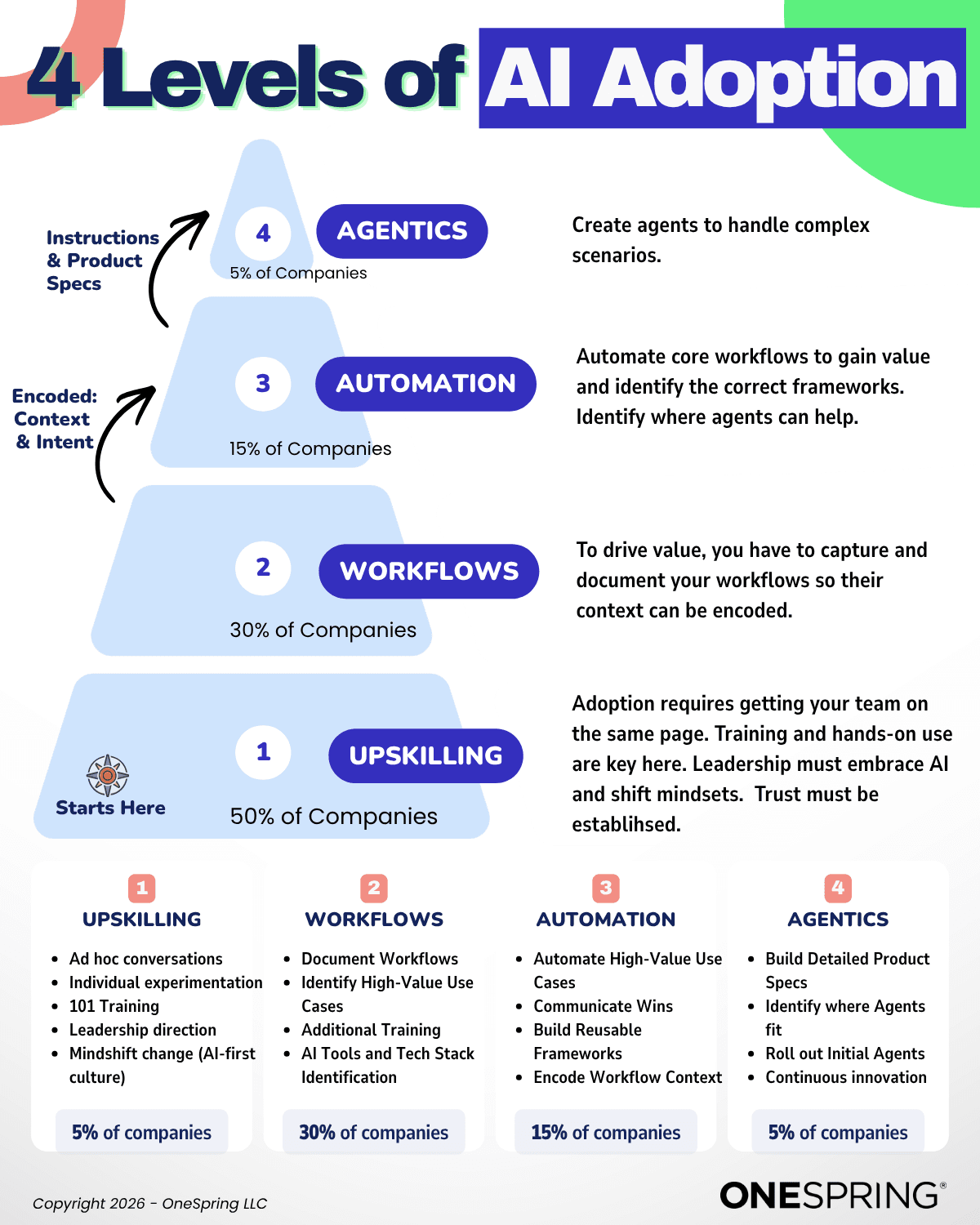
Image 1: 4 Levels of AI Adoption
This pattern is more common than most leaders want to admit. According to Gallup's Q4 2025 workplace data, 41% of organizations have not implemented AI tools at all, and nearly half of U.S. workers report they "never" use AI in their role. Meanwhile, Deloitte's 2026 State of AI report identifies the AI skills gap as the single biggest barrier to integration, with 53% of companies responding by educating their broader workforce before anything else.
The companies getting AI right aren't moving faster. They're moving in order. There are four distinct levels to AI adoption, and every company moves through them. The question isn't whether you'll follow this path. It's whether you'll follow it deliberately or stumble through it by accident.
Level 1: Upskilling
Where 50% of Companies Still Are
This is where every successful AI journey begins. Not with a software purchase, but with a mindset shift.
Upskilling means getting your team trained on AI tools, building confidence with the technology, and establishing the trust that makes everything above it possible. More critically, it requires leadership to lead. If executives aren't modeling curiosity and adoption, no amount of employee training will take hold.
"Insufficient worker skills are the biggest barrier to integrating AI into existing workflows." — Deloitte, 2026 State of Generative AI in the Enterprise
The data on this is stark. A SurveyMonkey Q3 2025 AI Sentiment Study found that only 13% of American workers said their company offered them any AI training. At the same time, 29% of employees admitted to using AI without telling their manager. People are finding the tools on their own because their organizations haven't created a structured path.
What Level 1 Actually Requires
Team training: Hands-on exposure to AI tools relevant to your business functions
Leadership alignment: Executives and managers who actively champion and use AI themselves
Psychological safety: A culture where experimentation is encouraged and mistakes are learning opportunities
Trust building: Transparent communication about how AI will (and won't) change roles
Without this foundation, nothing above it holds. You cannot automate workflows that your team doesn't understand or trust.
Level 2: Workflows
Where 30% of Companies Are
Before you can automate anything, you have to document everything.
This is the step most companies skip when they rush toward automation. They try to automate processes that have never been fully mapped, and they wonder why the output is inconsistent or incomplete. The reason is simple: AI can only work with what you give it.
Level 2 is about capturing how work actually gets done. Not how it's supposed to get done according to an org chart, but the real, step-by-step reality of your operations. Who does what, when, with what information, and to what standard.
This is where encoding happens. Encoding is the process by which domain knowledge gets captured so that it can be used by AI. It's the translation layer between human expertise and machine execution. Skip it, and your automation will be shallow. Do it well, and every level above becomes dramatically more powerful.
Why Workflow Documentation Is Harder Than It Sounds
Most organizations discover at this stage that their processes exist primarily in people's heads. Tribal knowledge, informal handoffs, and undocumented exceptions are the norm, not the exception. Surfacing this institutional knowledge is painstaking work, but it's also irreplaceable.
McKinsey's State of AI research confirms that redesigning workflows is a key success factor for AI high performers, with half of top-performing companies actively rebuilding their processes around AI rather than layering AI onto legacy ones.
The output of Level 2 isn't a software deployment. It's a library of documented, encoded processes that form the foundation for everything that comes next.
Level 3: Automation
Where 15% of Companies Are
Now you're ready to automate. Not before.
With a trained team and documented workflows in place, Level 3 is where AI starts delivering measurable business value. The approach here is deliberate: identify your highest-value, most repeatable tasks and automate those first.
Choosing the Right Starting Points
Not all automation is created equal. The best candidates for early automation share a few characteristics:
High frequency: Tasks that happen dozens or hundreds of times per week
Clear inputs and outputs: Processes where success is easy to define and measure
Low exception rate: Work that follows a predictable pattern most of the time
Meaningful time cost: Activities that consume significant team capacity without requiring human judgment
Starting here creates compounding returns. Early wins build organizational confidence, demonstrate ROI, and create reusable frameworks that make subsequent automation faster and cheaper.
Communicating those wins matters as much as achieving them. Teams that see AI delivering real results become advocates. Teams that hear about AI in the abstract remain skeptical. Show the numbers, share the stories, and make success visible.
The 15% of companies operating at this level are pulling ahead. Deloitte's 2026 report found that 66% of organizations report productivity and efficiency gains from AI, but only 34% are truly reimagining their business. Level 3 is where that reimagination begins.
Level 4: Agentics
Where Only 5% of Companies Are
This is where AI starts working independently.
Agentic AI refers to systems that can plan, make decisions, and execute across complex, multi-step scenarios without constant human intervention. Rather than responding to a single prompt, agents pursue goals. They gather information, take actions, evaluate results, and adjust course.
The use cases at this level are transformative: autonomous research and analysis, end-to-end customer service handling, dynamic supply chain optimization, and AI systems that coordinate with each other to complete complex workflows.
Only 5% of companies are operating here, and the gap is widening. Deloitte's research shows that agentic AI usage is poised to rise sharply in the next two years, but governance is lagging: only one in five companies has a mature model for overseeing autonomous AI agents.
The real risk at Level 4 isn't technical failure. It's deploying agents before your organization has the judgment and guardrails to manage them.
Companies that skip Levels 1 through 3 and attempt to jump directly to agentic AI face predictable problems: agents operating on undocumented processes, making decisions that contradict how the organization actually works, and teams that lack the AI fluency to identify when something has gone wrong.
The path to Level 4 is earned, not purchased.
The Biggest Mistake: Skipping Levels
The pressure to jump ahead is real. Board members want agentic AI. Competitors are announcing automation initiatives. Vendors are pitching Level 4 solutions to organizations that haven't completed Level 1.
The result is predictable. McKinsey's research found that while 88% of organizations report using AI in at least one business function, nearly two-thirds have not yet begun scaling AI across the enterprise. Adoption is widespread in name; deep in practice, it remains rare.
The gap between "we use AI" and "AI is transforming how we operate" comes down almost entirely to whether a company followed the levels in order.
Where Most Companies Actually Stand
Level | Focus | Share of Companies |
|---|---|---|
Level 1: Upskilling | People, mindset, training | ~50% |
Level 2: Workflows | Process documentation, encoding | ~30% |
Level 3: Automation | High-value task automation | ~15% |
Level 4: Agentics | Autonomous, multi-step AI systems | ~5% |
The distribution isn't random. Each level is harder to reach because it requires the previous one to be genuinely complete. Companies that try to shortcut the process don't skip ahead; they just create a more expensive version of Level 1 problems.
Build incrementally. The companies at Level 4 today didn't get there by moving fast. They got there by moving in order.
Start at Level 1. Do It Well.
Getting your people on board is the foundation. Not a nice-to-have, not a soft skills initiative, but the structural prerequisite for every other level of AI adoption.
If your organization is at Level 1, that's not a failure. It's the right starting point. The work of building AI confidence, shifting leadership mindset, and establishing trust with your team is the hardest and most important work you'll do on this journey. Everything else follows from it.
If you're at Level 2, the question isn't which automation tool to buy. It's whether your workflows are truly encoded, and whether the people who own those workflows understand why that documentation matters.
If you're at Level 3, the priority is communicating wins and building reusable frameworks, not expanding to more use cases before the first ones are proven.
And if you're thinking about Level 4, the question to ask isn't "which agent platform should we use?" It's "have we earned the right to operate at this level?"
Understanding what AI enablement actually means for your organization is the first step. The framework is clear. The order is non-negotiable. Start where you are, do it well, and the next level will follow.
If you're ready to assess where your organization stands and build a clear path forward, OneSpring's AI enablement services are designed to meet you at your level and move you through the framework with structure and speed.
About the Author:
This article is based on a recent post by the CEO of OneSpring, Jason Moccia, where he outlines a clear roadmap for AI adoption.
Frequently Asked Questions
What are the four levels of AI adoption?
The four levels are Upskilling (mindset and training), Workflows (documentation and encoding), Automation (task execution), and Agentics (autonomous goal-seeking systems).
Why do most companies get stuck at Level 1?
Many organizations fail to move past upskilling because they lack structured training, leadership alignment, or the psychological safety required for team-wide experimentation.
What is workflow encoding in AI?
Encoding is the process of capturing institutional domain knowledge and step-by-step processes into a documented format that AI can use for consistent execution.
Can a company skip directly to AI automation?
Skipping levels is the biggest mistake in AI adoption. Without Level 1 (upskilling) and Level 2 (workflow documentation), automation often fails due to inconsistent processes or lack of team trust.
What is Agentic AI (Level 4)?
Agentic AI refers to autonomous systems that can plan, make decisions, and execute multi-step tasks across complex scenarios without constant human intervention.
What is the distribution of companies across the AI adoption levels?
Research suggests ~50% are at Level 1 (Upskilling), ~30% at Level 2 (Workflows), ~15% at Level 3 (Automation), and only ~5% have reached Level 4 (Agentics).